Top MD Warns: Rub This 1 "Mineral" Behind Your Knees at Night to Reduce Restless Legs
By Dr. Andy Salazar, Medical Director, Peak Health Research
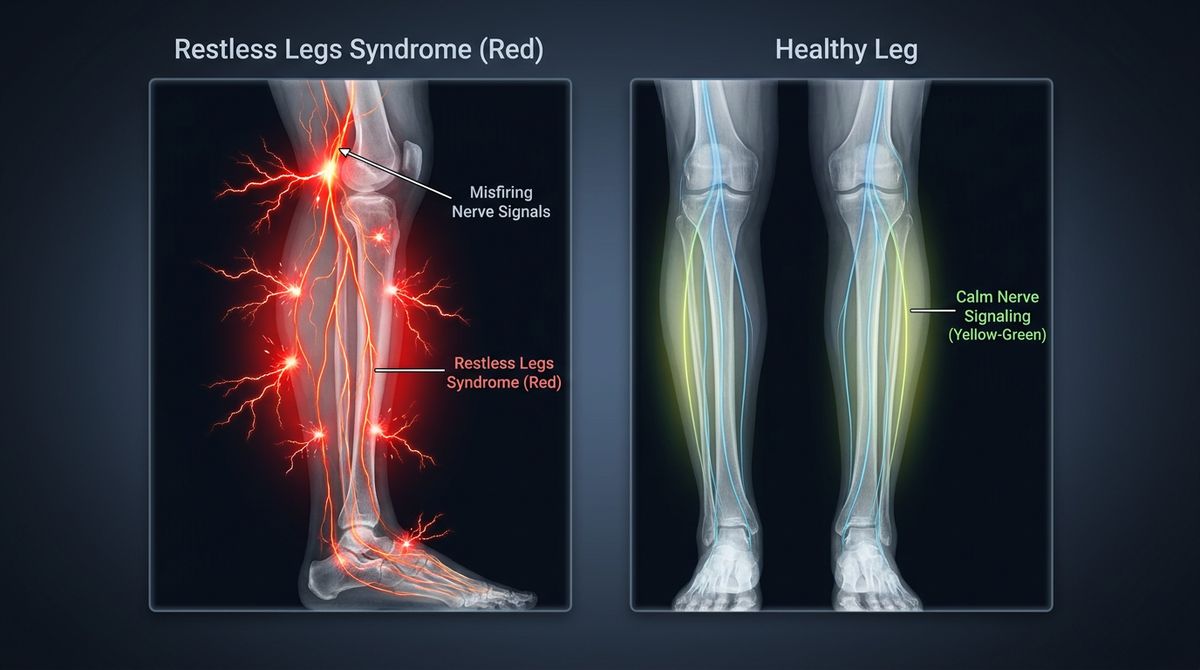
I'm about to piss off every sleep clinic, neurologist, and drug company that's spent years telling you the crawling in your legs is just something you have to live with.
Because what I'm about to show you could cost them a fortune. And after what I watched happen to a woman named Eleanor, I don't care anymore.
Eleanor is 66. She filled out a patient survey last spring, and in the box for "anything else you'd like us to know," she wrote nine words in capital letters:
"I HAVEN'T SLEPT IN THE SAME BED AS MY HUSBAND IN TWO YEARS."
Not because they'd fallen out of love. Because every night, the second her head hit the pillow, her legs came alive.
A deep, creeping, crawling itch, somewhere under the skin where no amount of scratching could reach it. She told me it felt like she wanted to put her hands right inside her legs and scratch her own bones.
The itch turned into a pull. The pull turned into a need to kick, to move, to get up and pace the hallway at 1 in the morning just to make it stop for thirty seconds. Then she'd lie back down, and it would start all over again.
She'd kicked her husband awake so many nights that one evening he turned on the light and said it plainly. Either she left the bedroom, or he would.
"I turned my own marriage into two separate bedrooms," she told me. "Over my legs."
By the time Eleanor sat in front of me, here's what the system had already put her through...
- Massage that felt wonderful for ten minutes and did nothing by bedtime.
- Stretching routines off the internet.
- Compression socks that squeezed her ankles all day and changed nothing at night.
- Hot baths at midnight, sometimes two or three in a single night.
- A bucket of water as cold as she could stand it, feet in until they went numb, just to buy twenty minutes of calm.
- Bottle after bottle of magnesium pills that promised the world and delivered a stomachache.
- She'd even rubbed a magnesium spray on her legs. No effect at all.
I knew the system had failed her
So I went rogue and discovered something that changed everything.
The problem was never in her legs.
Her legs were fine. Her muscles were fine. Her circulation was fine. Every spot she'd been rubbing and stretching and squeezing for two years... fine.
The crawling was a signal. A scrambled, misfired signal, sent down from her brain to her legs, over and over, all night long. And there was one very specific reason it only ever struck the moment she lay down to sleep.
Let me show you.
I'm Dr. Andy Salazar. I've spent twelve years as a licensed pain specialist, and I serve as Medical Director of Peak Health Research, an independent group that hunts down the natural fixes the drug industry would rather ignore.
And what I found when I dug into Eleanor's case, and thousands like it, flipped everything I thought I knew about restless legs on its head.
THE NIGHT SHE ALMOST GAVE UP
Before I get to what's actually happening in your legs, I need you to know I didn't take this seriously enough at first either.
When Eleanor first described it to me, I did what most doctors do. I checked her circulation. I checked her back. I ran the bloodwork. Everything came back "normal."
And I watched her face fall, because she'd heard "normal" a dozen times before. One doctor had told her it was a mental health problem and she should see a psychiatrist. Another said there was nothing to be done and wrote her a prescription for sleeping pills on the way out the door.
Her own family had spent years telling her she was crazy. That it was all in her head. An eye roll at the dinner table every time she got up to walk it off. And the cruelest part? After enough years, she'd started to wonder if they were right.
They weren't.
Here's the thing about restless legs that nobody sits you down and explains. There's no blood test for it. It's diagnosed entirely on what you tell the doctor. So decades of a person's own testimony, "my legs won't let me sleep, they haven't for twenty years," should have been enough.
Instead, most sufferers get waved off with drink more water, do some stretches, take it easy, you're just nervous.
Eleanor described her nights to me in a way I've never forgotten. She said the second she got sleepy, it started. And the more exhausted she got, the worse it got. And the worse it got, the more exhausted she became. A trap with no way out.
She'd worn an actual hole in her bedsheets from moving her legs so much. Some nights her fitness watch showed she'd walked ten thousand, fifteen thousand, sometimes twenty thousand steps... at night... inside her own house.
The night she almost gave up, she told me, she wasn't sad. She just felt hopeless that she'd ever have a normal life again.
That was the night I promised her I'd find the real answer. Not another pill. The actual reason her legs wouldn't listen to her.
THE DISCOVERY THAT CHANGED EVERYTHING
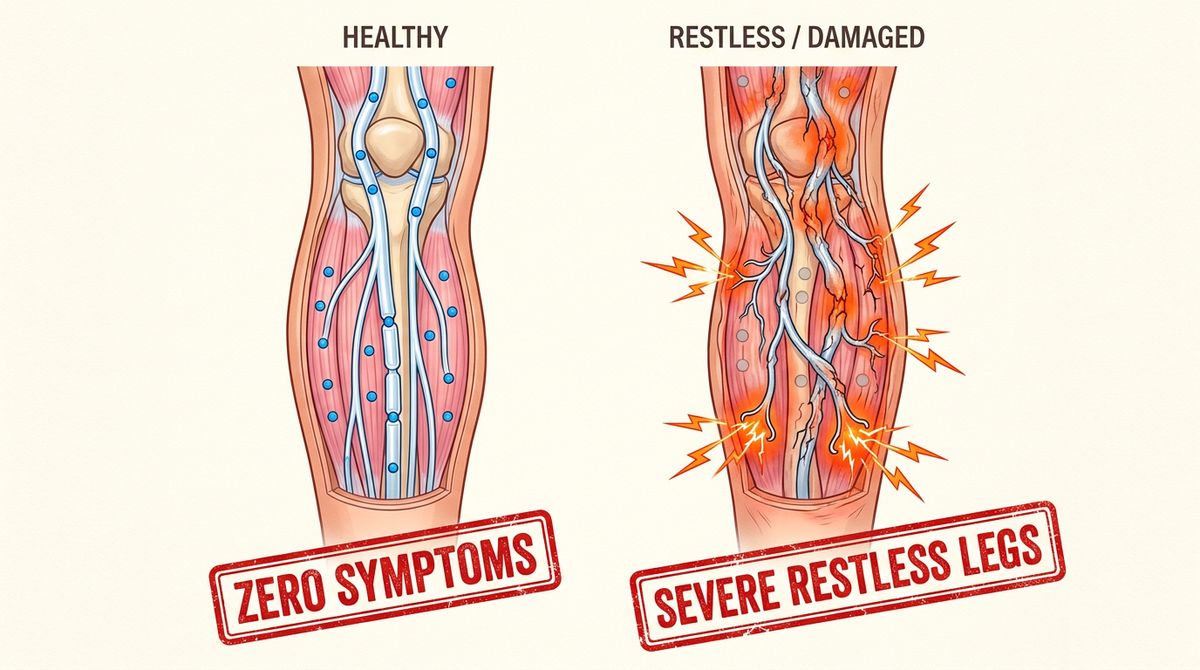
Every treatment Eleanor had ever been handed was aimed at her legs. The massage, the socks, the stretches, the rubs, even most of the pills.
But restless legs isn't a leg problem. It never was.
Here's what finally cracked the case open for me. Eleanor's legs, on every test, were healthy. And the strangest part: the moment she stood up and walked, the crawling eased. The second she lay back down, it roared back.
Sit with that for a second. If the trouble were really in the muscle or the blood flow, moving wouldn't flip it off and on like a switch. But a signal can. A signal can be drowned out the instant you move, and come screaming back the instant you go still.
And here's something no one ever told Eleanor. This isn't new, and it isn't some rare mystery. A physician named Thomas Willis wrote the first medical description of it back in 1685, more than three hundred years ago. Then in 1945, a Swedish neurologist named Karl-Axel Ekbom studied it so carefully he finally gave it a name. To this day the condition still carries both of theirs.
Three full centuries on the record. And the best anyone offered Eleanor was a shrug and a sleeping pill. Serious scientists had documented her exact torment for over 300 years. They just never solved the one part that actually matters. Why the signal fires, and how to quiet it so she could finally sleep.
That one question is what sent me digging. And it led me somewhere I never expected.
THE REAL ROOT CAUSE OF YOUR SLEEPLESS NIGHTS

It led me back to 1982, and to a neurologist in Turkey named Şevket Akpınar.
Akpınar had a hunch nobody else took seriously. What if restless legs wasn't a problem in the legs at all, but a problem with dopamine, one of the brain's own signaling chemicals? So he tried something no one had. He gave an RLS patient a medication used for Parkinson's disease, a drug whose entire job is to raise dopamine.
The crawling went quiet that same night.
That was the crack in the dam. For the first time, there was hard proof the problem was never in the legs at all. It was a signal. And it ran on dopamine.
In the decades since, researchers pieced together how, and once you see it, you can't unsee it.
Deep in your brain sits a small control center that acts like a night watchman. All day and night your legs fire off tiny sensory signals. Most are junk, background noise, and the watchman's whole job is to catch the junk and silence it before it ever reaches you. Think of it as a dimmer switch that turns the volume of your legs way down so you can rest. And that dimmer runs on dopamine.
Researchers at Emory even traced the wiring: a cluster of dopamine cells high in the brain that sends a single "brake" line all the way down the spinal cord. When that brake holds, the junk stays silent. It's the best explanation science has for what goes wrong in restless legs.
And here's the paradox that stumped me for months. Dopamine naturally dips in the evening and bottoms out at night, in every single one of us. So why do only some people's legs come alive? Because for most, that dimmer has enough power to ride out the nightly dip. For a person with restless legs, that same dip is the exact moment the brake loses its grip, and the watchman goes dark.
With no one silencing the junk, the spinal cord starts misfiring it straight down into the legs. That's the crawling. The fizzing, like soda in your veins. The creeping itch no scratch can reach. It isn't coming from your legs. It's a signal being screamed down at them from above.
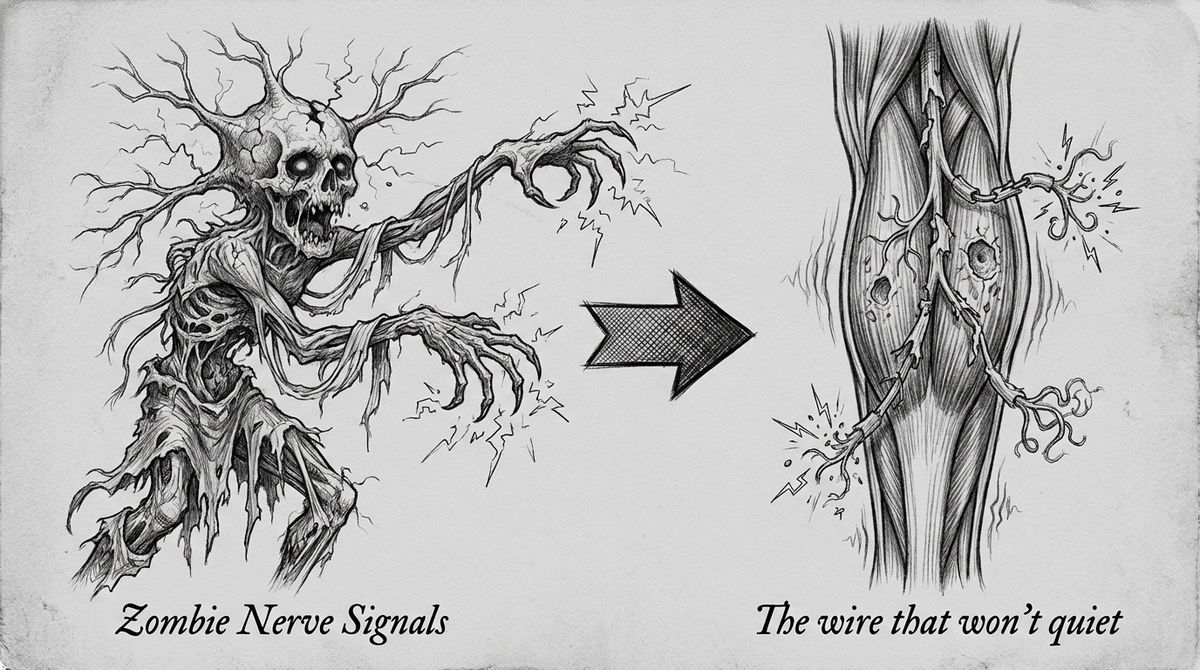
I started calling them zombie nerve signals. Signals that are supposed to die the moment you lie down to rest, but instead refuse to quit. They claw. They fizz. They crawl. They drag you up out of a warm bed at 1 a.m. and march you around your own kitchen, hour after hour, night after night, robbing you of the one thing every human body is supposed to get for free. Sleep.
There's a reason a wave of cold, or a hard rub, can quiet all this for a few minutes. Back in 1965, two researchers named Ronald Melzack and Patrick Wall proved that a stronger, clearer signal crowds a weaker, messier one right out of the gate. It's the same reason rubbing a banged elbow eases the sting. Hold onto that, because it's the whole key to what comes next.
And this is why it always, always hits the second you lie down. Sleep researchers who tracked patients around the clock found the crawling peaks near 1 in the morning and fades by late morning, no matter when they'd slept. The exact moment your body powers down is the exact moment that dimmer goes dark. One of my own patients said it better than any textbook: "It's like my brain is sending a false signal to my legs." He was more right than his doctors ever were.
Now, you might wonder what knocks that dimmer out of balance in the first place. There isn't one single cause. For some it runs in the family. For some it starts in pregnancy. For some it's tied to other medications. And researchers at Johns Hopkins found something remarkable: many sufferers are short on iron in the brain, the raw material dopamine is built from, even when the iron in their blood tests perfectly normal.
So please, don't run out and start megadosing iron on your own. Iron your body doesn't need can be genuinely dangerous, and swallowing a mineral does little to change what's happening in your brain anyway.
THE 15-MINUTE ANSWER THAT WAS HIDING IN PLAIN SIGHT
When I interviewed dozens of long-term sufferers, I kept hearing the same strange confession. The thing that gave them the most reliable relief wasn't a pill at all. It was cold.
A bucket of ice water. A bag of frozen peas. A cooling gel rubbed straight onto the legs. One woman kept a tube of drugstore muscle rub by her bed for exactly this reason.
At first I thought it was a coincidence. It isn't. It's the key to the whole thing.
Here's what cold actually does. Your skin is packed with cold-sensing nerve endings. In 2021, two scientists won the Nobel Prize in Medicine for pinning down the exact cold sensor menthol switches on, a tiny receptor on your nerves called TRPM8. Menthol is one of the only things on earth that opens it on command.
When you flood those nerve endings with a strong, clean cold signal, that signal travels up the very same nerve highway the crawling uses. And a loud, organized signal drowns out a weak, scrambled one. It's like a clear radio station overpowering static on the same frequency.
Scientists call it the gate. When you open the cold gate, the crawling signal can't get through.
That's why the ice bucket works. The problem is, you can't sleep with your feet in a bucket of ice water, and the relief ends the moment you warm back up.
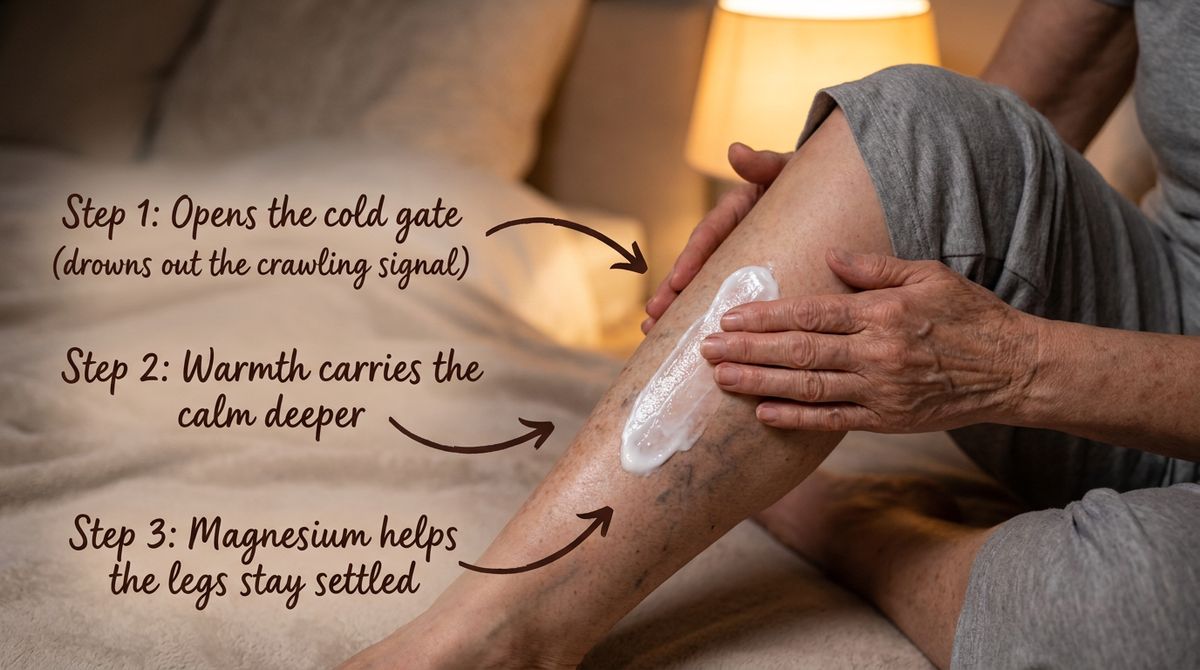
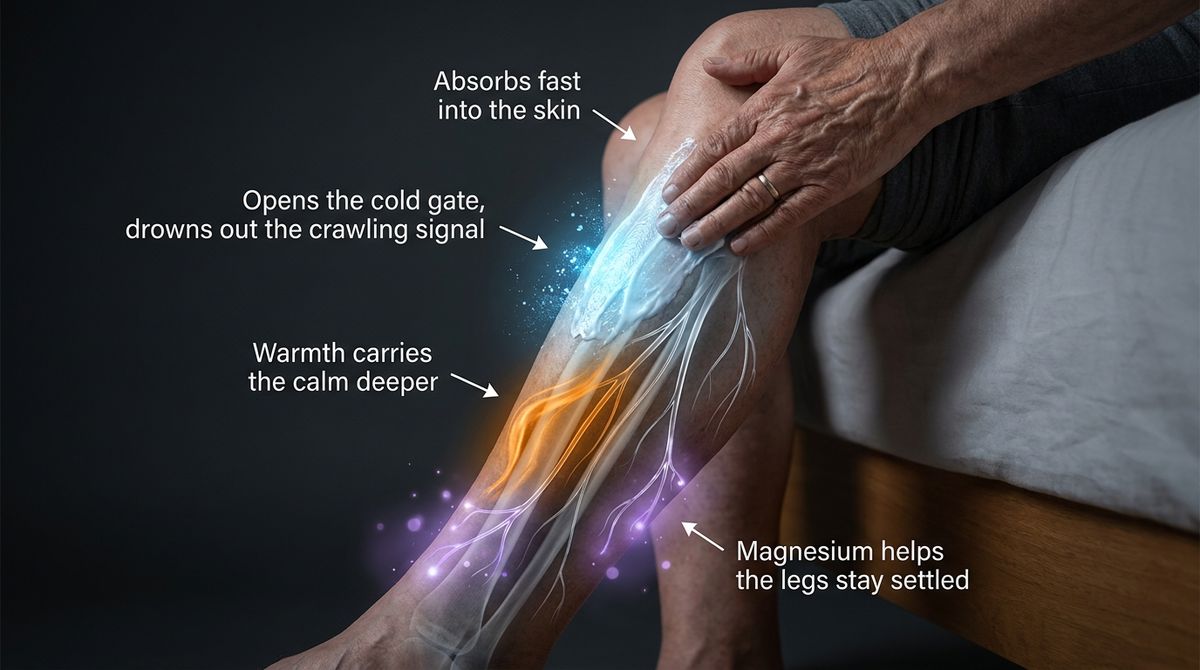
So I asked a simple question. What if you could deliver that same signal-drowning cold, plus a wave of gentle warmth to carry it deeper, plus the calming minerals the pills never got to your legs... all from something you could rub on in fifteen seconds and then close your eyes?
That's when Magnesium Freeze was born.
The very first jar went to Eleanor. She rubbed it on that night half expecting nothing, the way she'd expected nothing a hundred times before.
She called me the next morning and could barely get the words out. For the first time in longer than she could remember, her legs had gone quiet. No pacing. No hallway at 1 a.m. She'd fallen asleep, and stayed asleep.
"I keep waiting for it to come back," she told me. "And it just... didn't." That was the morning I knew I couldn't keep this in my office.
And Eleanor wasn't the only one. I gave a jar to a colleague of mine, Gwen, a nurse who'd spent thirty years on the night shift, her own legs crawling the second she finally lay down after a double. A week later she stopped me in the hallway and couldn't quite get the words out. "I slept eight hours," she said. "I can't tell you the last time I slept eight hours." A woman who'd spent her whole career helping other people rest, and she'd forgotten what it felt like herself.
That was when this stopped being about my own patients, and became about the millions of people still pacing their floors at 2 a.m.
WHY YOU'VE NEVER HEARD THIS FROM YOUR OWN DOCTOR
Let me be blunt about why something this simple has stayed a secret.
There's no money in it. There's a fortune, though, in a pill you swallow every single day for the rest of your life, at a dose that only ever climbs. The restless-legs drug business is worth billions, and it doesn't earn a cent the night you stop needing it. A cream you rub on and forget is a threat to the whole machine.
So when I started sharing what I'd found, the pushback came fast. I got the letters. I got the polite phone calls suggesting I'd be smart to stay in my lane. One of our suppliers got leaned on hard enough that they nearly walked.
I won't pretend none of it rattled me. But I'd already watched too many people like Eleanor pace their kitchens at two in the morning, sold a slow-motion trap and told to be grateful for it.
So let me tell you exactly where to aim your anger. Not at your family doctor. He was handed the same prescription pad and the same script as everyone else. Aim it at a system that quietly makes more money from your next refill than it ever will from your first full night of sleep.
Then let me show you what actually works.
INTRODUCING MAGNESIUM FREEZE


Magnesium Freeze is a drug-free topical cream you smooth onto your legs at night. It's not a pill. There's no dose to raise. There's nothing to augment. It works on the one thing every road to restless legs has in common: the signal itself.
And no, before you even think it, this isn't the magnesium spray you already tried and threw in a drawer.
A plain magnesium spray asks a single mineral to soak through skin that behaves like a sealed barrier. That's why it did nothing for you. Magnesium Freeze doesn't rely on that at all. It's a 12-in-1 formula built in three layers, and each layer does a different job on that misfired signal. Magnesium is in there, but it's one player on the team, not the whole show.
And I know the next thing you're thinking, because one of my patients admitted she already keeps a tube of drugstore muscle rub by her bed. So why not just use that?
Because a muscle rub is built to do one thing. Throw a few minutes of cheap cooling at a sore muscle, then quit. It was never built to hold a steady, engineered cold-then-warm signal on your nerves long enough for you to fall asleep, and it carries none of the calming nutrients or botanicals underneath. That's the difference between masking a sore muscle and quieting a misfiring signal.
Layer 1: The Signal Override (this is the one you feel).
This is the heart of it, the engineered version of the ice bath that already worked for you. It uses Menthol, which switches on your cold-sensing nerves and floods that shared nerve highway with a clean, loud cold signal that crowds the crawling out.
It's paired with Coolact 10, a trademarked cooling agent that stretches the cooling effect out to around twenty minutes instead of the three or four you get from ordinary menthol. Then Camphor and Hotact VBE, a trademarked warming agent, roll in behind the cold with a gentle warmth that can last up to two hours, carrying the signal deeper and keeping your legs quiet long enough to actually fall asleep.
Cold to drown the noise. Warmth to hold the calm. This is the ice bath in a tube, without the bucket.
Layer 2: The Nighttime Calm.
Underneath the cold and warmth sit two calming nutrients the pills could never get where you needed them. Vitamin B6 and Magnesium, the old muscle-and-nerve relaxers, rubbed straight onto the legs to help settle that restless, on-edge feeling so the quiet holds. They aren't the heavy lifting here, the signal override above does that. They just help your legs stay settled once it does.
Layer 3: The Settle-Down Shield.
Finally, six time-tested botanicals to soothe the legs and skin so the calm holds through the night: Arnica, used for two hundred years on sore, restless muscles. Frankincense oil, whose boswellic acids help quiet the same inflammation signals as prescription pills, without wrecking your stomach. Aloe vera to keep skin supple so the formula sinks in. Peppermint oil for a second cooling wave. Tea tree oil to calm and protect the skin. And Vitamin E, an antioxidant shield.
- Arnica, used for two hundred years on sore, restless muscles.
- Frankincense oil, whose boswellic acids help quiet the same inflammation signals as prescription pills, without wrecking your stomach.
- Aloe vera to keep skin supple so the formula sinks in.
- Peppermint oil for a second cooling wave.
- Tea tree oil to calm and protect the skin.
- And Vitamin E, an antioxidant shield.
Twelve ingredients. Three layers. One job: reach the signal your pills and your stretches and your socks never could.
HERE'S EXACTLY WHAT YOU'LL FEEL, IN ABOUT 15 MINUTES

Every set of legs is a little different, so give it a few nights to find its rhythm. But here's the pattern most people describe.
- Minutes 0 to 5, "The Quiet Falls." The cool hits first. Most people feel it in seconds, a clean cold rush spreading across the legs, and almost immediately the crawling has to compete with something louder. That desperate need to move starts to loosen its grip. One of my patients called it the first time in years her legs "stopped shouting."
- Minutes 5 to 10, "The Warmth Rolls In." The cold softens into a steady, comforting warmth that sinks in deeper, carrying the calm down into the muscle. The fizzing, buzzing feeling fades into the background. Your legs start to feel like they belong to you again, not to something living underneath your skin.
- Minutes 10 to 15, "Still." The botanicals settle in and the legs go quiet. Not numb. Not frozen. Not masked. Just still, the way legs are supposed to feel when you lie down. Most people tell me the same thing happens next. They stop bracing for the crawl... and they realize they're already drifting off.
For the first time in a long time, you're not dreading the bed. You're just... going to sleep.
THE RESULTS SPEAK FOR THEMSELVES

Over 30,000 people have reached for Magnesium Freeze in the last 18 months. More than 90% report significant relief within the very first week, and most tell us they've cut back or let go of the pills they used to lean on. Our refund rate sits at four tenths of one percent. That's four people in a thousand.
But the numbers aren't what I think about at night. The messages are.

Eleanor, 66: the woman I told you about, emailed me three weeks in. "I moved back into our bed," she wrote. "My husband cried. I cried. I'd forgotten what it felt like to just... lie there."
Ray, 71: a retired mail carrier, told me he'd worn a hole in his sheets and hadn't ridden in a car for more than an hour in years. "Drove to my grandson's game last weekend. Two hours each way. Sat still the whole time. I forgot what that even felt like."
Denise, 58: had it since her first pregnancy. "I used to dread going to bed because I knew I'd be in misery. Now I actually look forward to it. I don't recognize my nights anymore, in the best way."
Carol, 63: said it simplest. "I'm not going to tell you I'm cured. I still have the odd night. But they're softer, they're rarer, and I can finally sleep through most of them. Words can't describe what that's worth."
Magnesium Freeze is doctor formulated, made and shipped right here in the USA, non-greasy, fast-absorbing, and completely drug-free.
THE PRICE, AND WHY IT'S GOING TO UPSET SOME PEOPLE

Let me tell you what the "restless legs industry" wants from you instead.
They want you on a dopamine pill for the rest of your life, at a dose that climbs every single year. And here's what that road actually costs.
It starts cheap. A generic pill for a few dollars a month. Then augmentation sets in, the dose goes up, and they add a second prescription, then a third. The branded restless-legs pills, the ones with no generic version, run five to seven hundred dollars a month. That's over six thousand dollars a year for pills alone.
Then come the specialists. A sleep-clinic visit can run two to six hundred dollars before you've been handed a single answer. An overnight sleep study averages around three thousand dollars, and can top ten thousand. If they send you for iron infusions, that's five hundred to four thousand dollars a session, and a full course has been billed as high as seventeen thousand. The most stubborn cases end up on injectable medications north of two thousand dollars a month.
Add it up. Even a well-managed case runs hundreds to a couple thousand dollars every year. The harder road climbs to ten, fifteen, twenty-five thousand a year. Over a lifetime, families pour fifty to a hundred and fifty thousand dollars and more into chasing this thing. And at the end of it, for so many people, their legs are worse than the day they started.
THE 50% OFF "MIDDLE FINGER" TO THE MEDICAL ESTABLISHMENT

A formula like this, with trademarked cooling and warming agents and twelve active ingredients, could honestly sell for a small fortune.
We didn't want to price it like the industry we're trying to replace. So a single jar of Magnesium Freeze normally runs $69.
And right now, during this release, it's 50% off. That brings it down to $29 a jar. Less than a single specialist copay, for something you can use every night.
Call it my 50% middle finger to the refill machine. It should bother the right people that a jar you can use every single night costs less than one copay. Let it.
BUT HERE'S THE CATCH (AND IT'S A BIG ONE)

This 50% discount won't last forever. Not because I'm playing marketing games.
But because Magnesium Freeze™ relies on a high-grade mineral complex that requires a 6-week fermentation process.
We cannot just "make more" overnight. We've sold out 11 times in the past.
Also... and this is important... we have less than 1,000 units left at this price. Our lab can only produce 500 per week.
If you're reading this right now, units are still available. But I cannot promise they'll last through the weekend.
Most people don't order one. They order three, because once your legs go quiet you don't want to run out, and the savings on a bundle are real.
MY 180-DAY "SLEEP AGAIN OR IT'S FREE" GUARANTEE

I'm not going to ask you to trust a stranger on the internet with your worst nights. So I'm taking all the risk off your shoulders.
Use Magnesium Freeze every night for up to 180 days. That's six full months. If your legs don't go quieter, if you don't sleep better, if it doesn't do what I've promised, email my team the words "didn't work" and we'll refund every penny. No forms. No questions. No sending anything back. Refunds go out within 48 hours.
And you're never talking to a machine. My team answers at [email protected] or 1-888-811-1186, a real person, day or night.
Six months to decide, in your own bed, on your own nights. That's how sure I am.
THE CHOICE IN FRONT OF YOU TONIGHT

Picture the next year if nothing changes.
The same 1 a.m. hallway. The same worn-out sheets. Another year of climbing into a separate bed, or watching someone you love climb out of yours, until the guest room stops feeling temporary. And if you're on the pills, the same slow creep of a dose that keeps rising while the crawling reaches up into your arms. That's not fear talk. That's just the road you're already on, playing itself out, one stolen night at a time.
Now picture the other one.
Fifteen minutes from now, your legs quiet. Tonight, actual sleep. A week from now, waking up rested enough to forget your legs were ever a problem. A month from now, lying still next to the person you love again, the way Eleanor does now. All of it riding on something that costs less than one copay and comes with six full months to prove itself, or your money back.
One road asks you to keep paying, in dollars and in sleep, for the privilege of slowly getting worse. The other asks you to try a cream for a single night. That's the whole decision.
HERE'S WHAT TO DO NEXT

1. Click the button below that says "APPLY DISCOUNT & CHECK AVAILABILITY"
2. Choose your package (Pro tip: Get at least 3 jars. You'll want backups when this works. Plus you'll save more.)
3. Fill out your shipping info (We ship same-day if you order before 3pm EST)
4. Wait for your package to arrive (Usually 3-5 days)
5. Use it the moment it shows up
6. Email us your success story in a week (Seriously. Our team loves hearing these: [email protected])
Click below. Let's end this nightmare. Tonight.

GET 50% OFF Magnesium Freeze™ Now!You can take advantage of this unique offer for 3 days only! INTERNET ONLY OFFER
FOR A LIMITED TIME: Ordering now makes you eligible for 50% OFF Magnesium Freeze™. Only available here. Limited to first 2,184 units only.
With hope,
Dr. Andy Salazar Peak Health Research
P.S. Remember the one thing that finally made sense of all of it. Your restless legs were never the problem. They were only ever the place you felt a signal misfiring from above, the loudest at night, when your body's own dimmer switch goes dark. You don't have to chase which cause is yours. You just have to reach the signal. That's the whole idea behind Magnesium Freeze, and it's waiting on the other side of that button.
P.P.S. If you've been told it's all in your head, or you're just nervous, or there's nothing to be done, I want you to hear a doctor say this plainly: you weren't imagining it, and you weren't crazy. Decades of your own testimony were always enough. Give your legs fifteen minutes tonight and let them prove it.
P.P.P.S. The 50% release price holds only while this batch lasts. When the jars run low, the page comes down until we can make more. If it's still here when you're reading this, it's still available. I wouldn't wait.